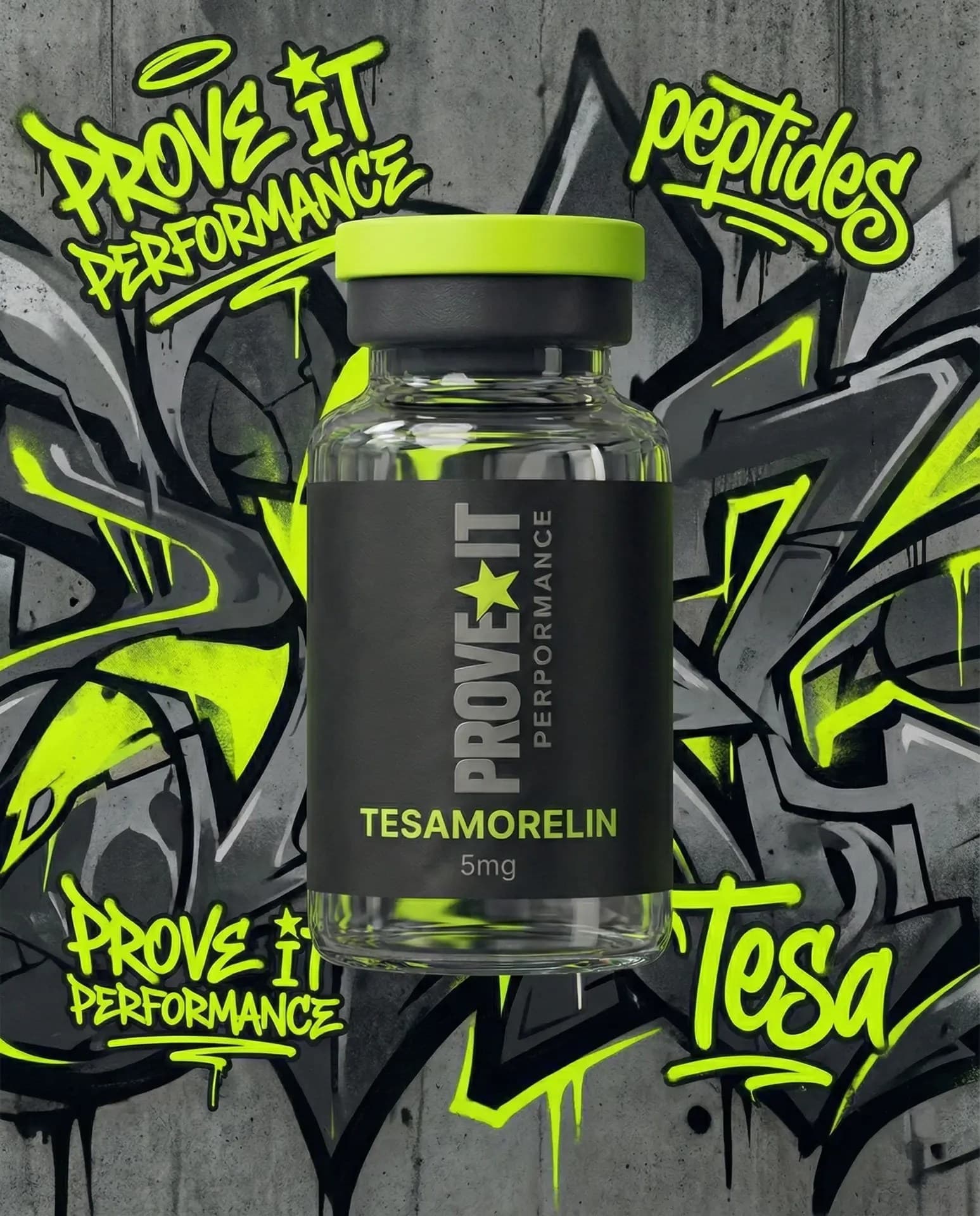
Tesamorelin is a synthetic analog of endogenous human growth hormone releasing hormone (GHRH) studied in research for its activity at the GHRH receptor (GHRHR). It is catalogued under CAS number 901758-09-6 with a molecular formula of C₂₂₁H₃₆₆N₇₂O₆₇S and a molecular weight of approximately 5135 Da. Unlike sermorelin, which represents the truncated first 29 amino acids of endogenous GHRH, tesamorelin is based on the complete 44-amino-acid sequence of human GHRH — stabilized at the N-terminus with a trans-3-hexenoic acid modification. It is supplied as a lyophilized powder for laboratory research and is intended solely for research purposes, not for human use.
Within the GHRH agonist research category, tesamorelin occupies a structurally distinct position from shorter synthetic fragments. Its full-length GHRH backbone provides the complete receptor contact surface, and the N-terminal modification distinguishes it pharmacokinetically from the native peptide. For researchers examining GHRH axis signaling, the combination of a full-length receptor-engagement sequence and an engineered stability modification makes tesamorelin a well-characterized probe for studying GHRHR pharmacology at the pituitary level.
What is the molecular structure of tesamorelin?
Tesamorelin is built on the complete 44-amino-acid sequence of human GHRH(1-44)-NH₂ — the same full-length peptide produced endogenously in the hypothalamus — with one key structural modification: the native N-terminus is conjugated to a trans-3-hexenoic acid moiety. This modification is added at the alpha-amino group of the first residue (tyrosine at position 1) to confer resistance to dipeptidyl peptidase IV (DPP-IV) cleavage, the enzyme primarily responsible for rapid inactivation of native GHRH in circulation.
The molecular formula is C₂₂₁H₃₆₆N₇₂O₆₇S, with the sulfur atom contributed by a methionine residue within the 44-amino-acid chain — the same oxidation-susceptible residue that is a handling consideration for all GHRH-class peptides. The compound's molecular weight of approximately 5135 Da places it substantially larger than shorter synthetic fragments like sermorelin (3357.9 Da) and far larger than ghrelin receptor agonists like ipamorelin (711.9 Da). The C-terminal amide (-NH₂) is preserved from the native GHRH sequence, which published structural analyses identify as necessary for full GHRHR binding activity. The lyophilized form is a white to off-white powder.
What receptor does tesamorelin target?
Published research characterizes tesamorelin as an agonist at the growth hormone releasing hormone receptor (GHRHR), a class B G-protein-coupled receptor expressed primarily on anterior pituitary somatotroph cells. GHRHR is classified as a class B (or secretin-family) GPCR — a structurally distinct subfamily from the class A GPCRs that include the ghrelin receptor (GHSR-1a) targeted by ipamorelin and other growth hormone releasing peptides.
GHRHR engages its ligand through a two-domain binding mechanism typical of class B GPCRs: the extracellular N-terminal domain of the receptor makes initial contact with the C-terminal portion of the ligand, and the transmembrane bundle accommodates the ligand's N-terminal helix to complete the binding interface. The full-length GHRH(1-44) sequence provides contact points for both domains, which is the structural rationale for why full-length GHRH — and by extension tesamorelin — is studied as having a complete receptor engagement profile rather than a truncated interaction surface.
How does tesamorelin's N-terminal modification affect receptor pharmacology in research models?
The trans-3-hexenoic acid modification at tesamorelin's N-terminus is the structural feature that most directly distinguishes it from native GHRH and shorter synthetic fragments like sermorelin. DPP-IV, a serine protease expressed in plasma and on the surface of endothelial cells, cleaves the His-Ala bond at positions 2-3 of the native GHRH sequence — rapidly inactivating endogenous GHRH in circulation. Published research on GHRH analog design establishes that N-terminal modification can block this cleavage site without abolishing receptor agonist activity.
Tesamorelin's N-terminal hexenoic acid group occludes the DPP-IV cleavage site while preserving the critical tyrosine-1 residue and the downstream helical structure required for GHRHR engagement. Structural characterization studies indicate that the helical secondary structure of the GHRH peptide backbone is maintained in tesamorelin, which is mechanistically important because GHRHR agonism is sensitive to disruptions in the helical conformation of the ligand's N-terminal region. The modification is therefore designed to be pharmacokinetically stabilizing without being pharmacodynamically disruptive — a distinction researchers account for when interpreting tesamorelin data relative to native GHRH reference comparisons.
What is the downstream signaling cascade activated by tesamorelin at GHRHR?
GHRHR couples primarily to the Gs protein, which upon receptor activation dissociates and stimulates adenylyl cyclase. Adenylyl cyclase catalyzes the synthesis of cyclic AMP (cAMP) from ATP, and the resulting intracellular cAMP accumulation is the primary second messenger event in the GHRHR signaling cascade. Elevated cAMP activates protein kinase A (PKA), which phosphorylates downstream effectors including the transcription factor CREB (cAMP response element-binding protein) and other regulatory proteins involved in GH gene expression and vesicular secretion in pituitary somatotrophs.
Published research also documents a secondary calcium-dependent component to GHRHR signaling in somatotrophs. GHRHR stimulation is associated with voltage-gated calcium channel opening and intracellular calcium elevation, which potentiates GH secretion beyond what cAMP signaling alone accounts for in cell culture models. This dual cAMP and calcium mechanism — both downstream of Gs coupling at GHRHR — distinguishes GHRHR signaling from the calcium-primary mechanism of GHSR-1a, which operates via Gq/G11 and bypasses adenylyl cyclase. Tesamorelin, as a full-length GHRHR agonist, is studied in the context of this full Gs/cAMP/PKA cascade.
How does tesamorelin compare to sermorelin and CJC-class GHRH analogs in research design?
The GHRH agonist research category includes several compounds that act at the same receptor but differ in length, modification strategy, and pharmacokinetic profile. Understanding these structural distinctions is important for experimental design.
Property
Tesamorelin
Sermorelin
CJC without DAC
GHRH residues
Full-length (1-44)
Truncated (1-29)
Truncated (1-29)
N-terminal modification
trans-3-hexenoic acid
None (acetate salt)
Unmodified
CAS number
901758-09-6
86168-78-7
446036-97-1
Approx. molecular weight
~5135 Da
3357.9 Da
~3367 Da
DPP-IV stability
Engineered resistance
Susceptible
Susceptible
Sermorelin represents the minimum active GHRH fragment — the 1-29 N-terminal sequence that retains receptor binding and activation activity. CJC without DAC (also called Modified GRF 1-29) is a 1-29 fragment with amino acid substitutions at positions 2, 8, 15, and 27 designed to confer DPP-IV resistance without an additional chemical conjugate. Tesamorelin takes a different approach: it preserves the complete 44-amino-acid backbone for full receptor engagement and adds the N-terminal hexenoic acid group for DPP-IV resistance. Research comparing these approaches uses them as mechanistic tools for interrogating which structural elements of GHRH are required for various aspects of GHRHR pharmacology, receptor affinity, and signaling output in model systems.
What does published research describe about GHRH pulsatile signaling as it relates to tesamorelin?
The GH axis operates through pulsatile secretion governed by opposing hypothalamic signals: GHRH drives episodic GH release, while somatostatin (also called somatotropin-release inhibiting factor, SRIF) suppresses it. In physiological systems, GHRH and somatostatin are secreted in alternating phases, producing the characteristic pulsatile pattern of GH release. Research examining GHRH analogs like tesamorelin must interpret experimental observations within this pulsatile signaling framework.
Published studies examine GHRHR agonism in the context of its interaction with somatostatin-mediated inhibition. Somatostatin acts via Gi-coupled receptors that suppress adenylyl cyclase — directly opposing the cAMP elevation induced by GHRHR activation. The competitive dynamics between these two pathways determine the net GH secretory output in preclinical models, and the timing of GHRHR agonist application relative to the somatostatin tone in the experimental system is an important variable in study design. Tesamorelin's engineered DPP-IV resistance is mechanistically relevant here because it affects the duration of GHRHR engagement available to compete with somatostatin inhibition in model systems where the compound is not immediately inactivated by plasma proteases.
Additionally, pituitary somatotroph desensitization following continuous versus pulsatile GHRHR stimulation is documented in the literature as a research consideration. GHRHR undergoes receptor internalization and downregulation with sustained agonist exposure, and experimental protocols examining tesamorelin must account for these regulatory mechanisms when comparing pulsatile versus continuous stimulation paradigms.
What is known about tesamorelin's stability and handling in research?
Tesamorelin is supplied as a lyophilized powder and stored at −20°C to preserve structural integrity. The compound shares the oxidation-susceptibility profile of all methionine-containing GHRH-class peptides: the methionine residue within the 44-amino-acid chain can undergo oxidation to methionine sulfoxide under exposure to oxygen, peroxides, or elevated temperatures, which degrades the compound's pharmacological activity and analytical purity profile. Protecting lyophilized tesamorelin from oxidizing environments, minimizing moisture exposure, and limiting freeze-thaw cycling are standard handling practices documented in the peptide research literature for this compound class.
Tesamorelin's molecular weight of approximately 5135 Da places it in the larger range of lyophilized research peptides, which can affect reconstitution behavior relative to smaller fragments. The trans-3-hexenoic acid N-terminal modification does not substantially alter the lyophilized stability profile of the peptide backbone relative to native GHRH, but its presence is a distinguishing feature that should be confirmed in Certificate of Analysis documentation when sourcing the compound. Mass spectrometry confirmation of the intact modified peptide — including verification of the N-terminal conjugate — is a standard quality control measure for research-grade tesamorelin. For how to read the chromatogram behind a reported purity figure, see reading an HPLC chromatogram. This article does not provide reconstitution or preparation instructions; all handling protocols are determined by the researcher according to their experimental requirements and applicable regulations.
How does Prove It Performance source tesamorelin?
Prove It Performance supplies tesamorelin as a research-grade compound with HPLC purity verification and mass spectrometry identity confirmation included in the batch-specific Certificate of Analysis on file for that batch. For guidance on evaluating research peptide supplier documentation and quality standards, see research peptide supplier qualification.
Researchers can review specifications, available sizes, and pricing on the tesamorelin product page, or browse the full catalog at all compounds. For the complementary GHRH fragment studied alongside full-length analogs, see our sermorelin acetate research overview, and for the ghrelin receptor agonist class that acts via the complementary GHSR-1a pathway, see our ipamorelin research overview. All material is intended for laboratory research use only.
This compound is a research chemical intended for laboratory and scientific research purposes only. It is not a drug, supplement, or food, and is not intended to diagnose, treat, cure, or prevent any disease. Prove It Performance does not sell products intended for human use. Researchers are responsible for compliance with all applicable local, state, and federal regulations.
Stay in the loop
New compounds, research updates & exclusive subscriber deals.