What is CJC no DAC in the context of cellular signaling research?
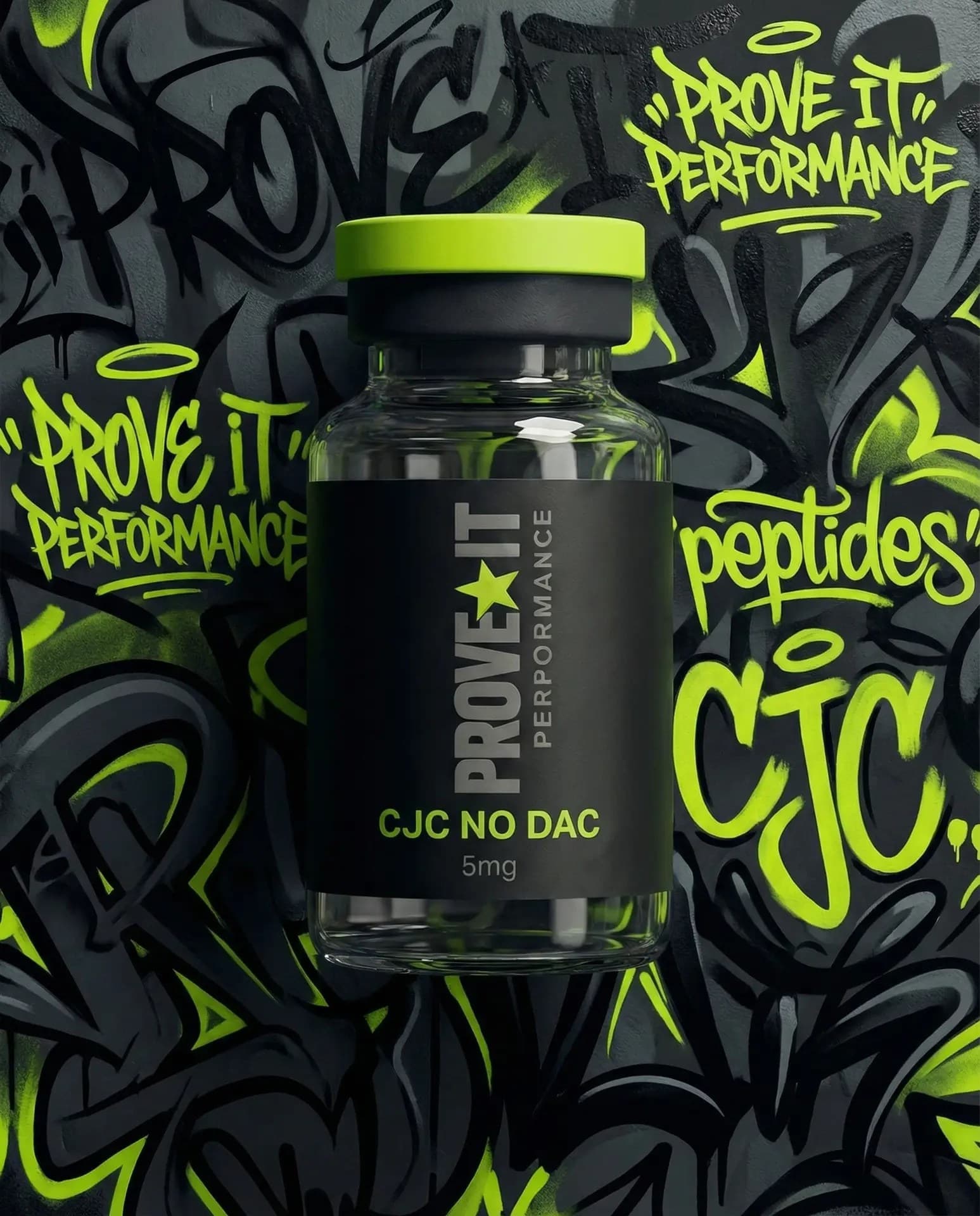
CJC no DAC is a synthetic analog of the first 29 amino acids of growth hormone releasing hormone, written GHRH(1-29)-NH2, with substitutions that resist cleavage by dipeptidyl peptidase IV. It lacks the albumin-binding linker of the longer-acting variant. The catalog lists CAS 446036-97-1, formula C152H252N44O42 and a molecular weight of 3367.9 Da.
In signaling research it serves as a stabilized reference agonist at the GHRH receptor. Its value is that it activates a well-characterized intracellular cascade while staying intact long enough to be measured, which is difficult with the unmodified fragment.
Which receptor and G protein does the signal start from?
The starting point is the growth hormone releasing hormone receptor (GHRHR), a class B (secretin-family) G-protein-coupled receptor found on anterior pituitary somatotroph cells. Class B receptors bind peptide ligands in two steps: the large extracellular N-terminal domain engages the C-terminal part of the ligand, and the ligand N-terminus then enters the transmembrane bundle, which is the step associated with activation.
Activation couples GHRHR mainly to the stimulatory G protein Gs. The alpha subunit exchanges GDP for GTP, dissociates from the beta-gamma dimer, and stimulates adenylyl cyclase. That single coupling choice defines the experimental toolkit: nearly every standard readout for this receptor is a readout of cyclic AMP or of something downstream of it.
What happens downstream of Gs in the cascade?
Adenylyl cyclase converts ATP to cyclic AMP, which binds the regulatory subunits of protein kinase A and releases its catalytic subunits. Those subunits phosphorylate a set of targets, including the transcription factor CREB at a serine residue. Phosphorylated CREB binds cAMP response elements in gene promoters, which is why cAMP-driven transcription is a routine endpoint.
Each node gives a measurable output. Cyclic AMP itself can be quantified by competitive immunoassay or by resonance energy transfer biosensors. PKA activity can be read through phosphorylation of its substrates. CREB activation can be read through a luciferase reporter under a cAMP response element. Choosing among them depends on the question: a cAMP assay reports proximal receptor coupling within minutes, while a reporter integrates signal over hours.
How is a cAMP signaling experiment typically built?
A standard design proceeds in a fixed order:
Plate cells that express the receptor, either a primary or immortalized somatotroph model or a heterologous line transfected with GHRHR.
Pre-incubate with a phosphodiesterase inhibitor so accumulated cAMP is not broken down before measurement.
Add a range of ligand concentrations, including a vehicle-only baseline, and hold for a fixed time.
Lyse the cells and measure cAMP by immunoassay or biosensor signal.
Fit a concentration-response curve and report an EC50 and a maximal response relative to a reference agonist.
The central design choice is concentration range. Peptide agonists at class B receptors often act in the low nanomolar range, so a curve spanning several orders of magnitude is needed to define both the lower plateau and the maximum. Reported potency values differ between laboratories, and receptor expression level, cell background and buffer composition are the usual explanations.
What controls separate a real receptor signal from artifact?
A cAMP signal can come from sources other than the receptor, so controls carry much of the interpretive weight.
A receptor-negative cell line or untransfected parental cells show whether the response depends on GHRHR. A direct adenylyl cyclase activator shows whether the cells can produce a cAMP signal at all, which separates a receptor-level problem from a downstream one. A receptor antagonist, where one is available, should shift the curve to the right. A vehicle-only condition sets the baseline, and a nonspecific peptide control rules out effects from peptide adsorption or buffer components.
Peptide integrity is the control that is easiest to skip. If a lot has degraded, the apparent EC50 shifts for reasons unrelated to biology. The peptide degradation pathways by sequence article describes the chemical changes that matter for peptides of this size, and reading HPLC chromatograms covers how to check a lot before use.
How do researchers study cross-talk with the ghrelin receptor pathway?
Cross-talk designs pair a GHRH-class agonist with a ghrelin-receptor agonist. Ipamorelin, listed here with CAS 170851-70-4, formula C38H49N9O5 and a molecular weight of 711.9 Da, acts at the growth hormone secretagogue receptor GHSR-1a. That receptor is structurally unrelated to GHRHR and couples mainly through Gq and G11, raising intracellular calcium through phospholipase C rather than raising cAMP.
Because the two pathways are mechanistically independent, a combined condition tests whether signals interact. The published literature on this class describes a larger combined response than the sum of the single-agent responses in pituitary models, and a cross-talk experiment is built to quantify that. The design needs three arms (each agonist alone, plus the combination) at matched concentrations, with both a cAMP readout and a calcium readout so each pathway can be tracked separately. The molecular weight gap is worth noting when preparing equimolar solutions: 3367.9 Da against 711.9 Da means equal mass is far from equal moles.
How does CJC no DAC compare with other GHRH-class reference ligands?
Sermorelin acetate is the unmodified fragment comparator, with the formula C149H246N44O42S. Running it in parallel with CJC no DAC isolates the effect of the substitutions on assay window and degradation kinetics, because both engage the same receptor and pathway. Tesamorelin, formula C221H366N72O67S, is a larger stabilized analog and is useful when a longer ligand is the variable under study. For a deeper look at the unmodified comparator, see the sermorelin acetate research overview.
What are the main limits of cellular signaling data?
Signaling in cultured cells is a model, and its limits matter for interpretation. A cell line may express receptor at a level far above or below native tissue, which changes apparent potency and the size of the cross-talk effect. Desensitization after prolonged stimulation shortens the useful time window, so a timecourse is better than a single endpoint. Serum components, plastic adsorption and protease activity in culture medium all change how much ligand actually reaches the receptor.
None of this is a defect in the method; it is a reason to report conditions in full: cell type, receptor expression, medium, incubation time, and peptide lot. Results from one system should not be extended to another without testing, and a cell-based finding says nothing about whole-organism behavior.
Closing note
CJC no DAC is used in cellular signaling research as a stabilized GHRH-class reference agonist, with Gs-coupled cAMP signaling as the central readout and ghrelin-receptor agonists as the usual cross-talk partner. Reliable results depend on matching catalog identifiers to lot documentation and on controls that separate receptor signal from artifact. All material is intended for laboratory research use only.
This content is provided for research and educational purposes only. The compounds discussed are research chemicals intended for laboratory use. They are not drugs, supplements, or food, and are not intended to diagnose, treat, cure, or prevent any disease. Prove It Performance does not sell products intended for human use. Researchers are responsible for compliance with all applicable local, state, and federal regulations.
Reference
Common questions
It is used to study the Gs-coupled pathway downstream of the growth hormone releasing hormone receptor. Receptor engagement activates adenylyl cyclase, raises intracellular cyclic AMP and activates protein kinase A. Researchers measure this with cAMP accumulation assays or cAMP-responsive reporter constructs in cultured cell models.
Native GHRH fragments are cleaved quickly by dipeptidyl peptidase IV in biological matrices, which shortens the usable assay window. CJC no DAC carries substitutions designed to resist that cleavage, so signal duration reflects receptor biology more than ligand degradation. Protease inhibitors and stability checks are still standard.
A vehicle-only condition sets the baseline, a receptor-negative cell line confirms the response depends on the receptor, and a direct adenylyl cyclase activator confirms the cells can produce a cAMP signal at all. A phosphodiesterase inhibitor is often included so accumulated cAMP is not degraded before measurement.
The catalog lists CAS 446036-97-1, molecular formula C152H252N44O42 and a molecular weight of 3367.9 Da, with a purity specification of at least 99 percent by HPLC. These values should be matched against the certificate of analysis for the specific lot before any signaling work begins.
Stay in the loop
New compounds, research updates & exclusive subscriber deals.