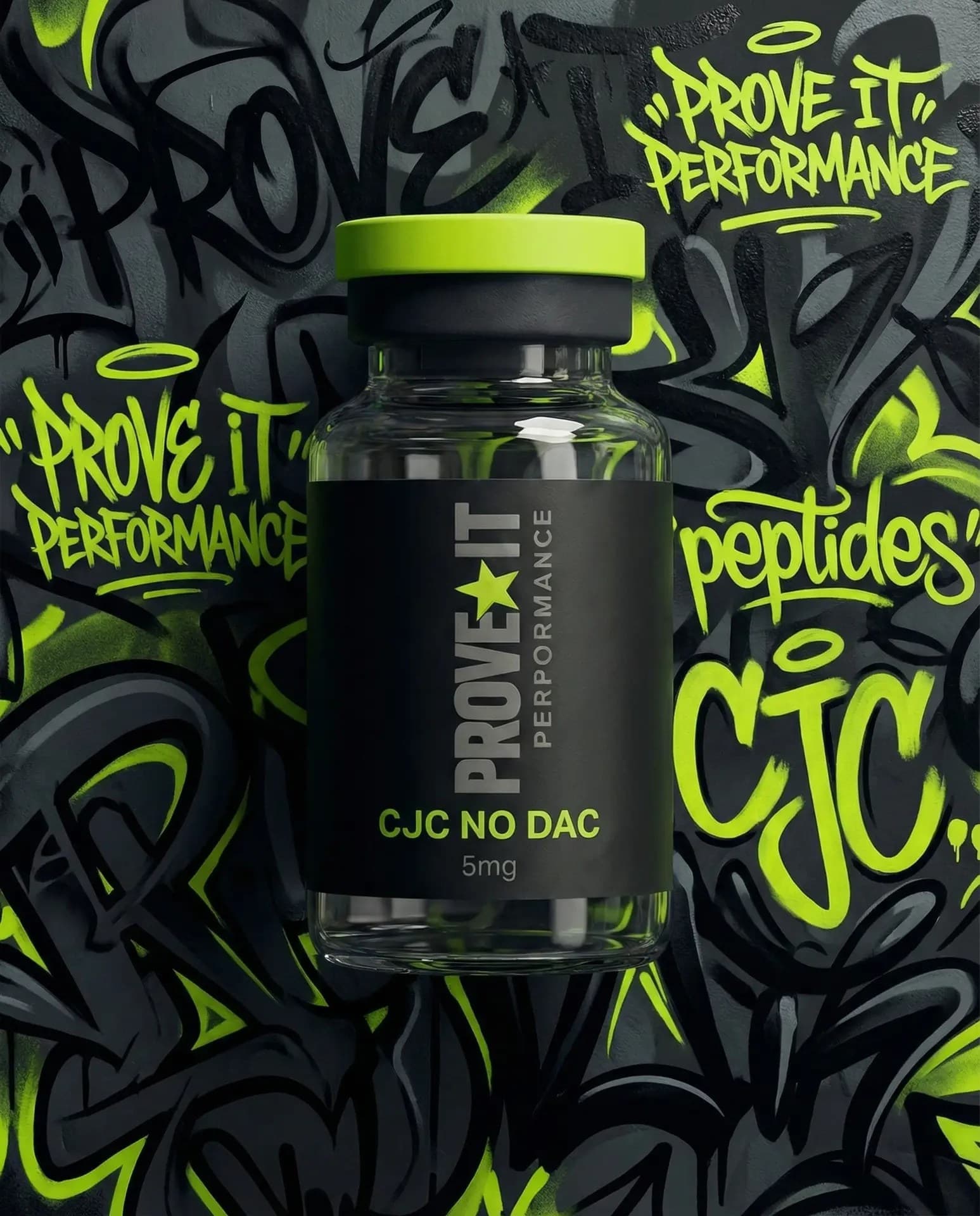
CJC no DAC is a synthetic analog of the first 29 amino acids of human growth hormone releasing hormone, the fragment commonly written GHRH(1-29)-NH2. The "no DAC" label means it carries no drug affinity complex, the maleimidopropionic acid linker used on the longer-acting variant. It is also known in the literature as modified GRF(1-29). In this catalog it is listed with CAS 446036-97-1, molecular formula C152H252N44O42 and a molecular weight of 3367.9 Da, supplied as a lyophilized powder with a purity specification of 99 percent by HPLC.
Its relevance to receptor binding work comes from its structure. Amino acid substitutions at selected positions in the 1-29 sequence are designed to reduce cleavage by dipeptidyl peptidase IV and to stabilize the helical conformation, while leaving the residues that contact the receptor intact. For a researcher running binding or competition assays, that combination gives a ligand that stays intact longer in biological matrices than the native fragment, which simplifies interpretation of apparent affinity.
Which receptor is the target in a binding study?
The target is the growth hormone releasing hormone receptor, GHRHR, a class B (secretin-family) G-protein-coupled receptor expressed on anterior pituitary somatotroph cells. Class B receptors bind peptide ligands through a two-site mechanism. The large extracellular N-terminal domain engages the C-terminal portion of the ligand first, and the N-terminal portion of the ligand then docks into the transmembrane bundle, which is the step associated with receptor activation.
For binding studies, that architecture matters because it means affinity is contributed by two regions of the peptide. Truncations or substitutions at either end can shift apparent affinity and efficacy independently. A modified 1-29 analog such as CJC no DAC retains enough of both regions to bind, which is why it is widely used as a reference GHRH-class ligand.
How are receptor binding assays typically designed for this class?
Two formats dominate. Saturation binding uses a labeled ligand at increasing concentrations against a fixed amount of receptor-bearing membrane or cell preparation, producing a dissociation constant (Kd) and a maximum binding capacity (Bmax). Competition binding holds the labeled ligand at a fixed concentration and adds increasing concentrations of an unlabeled competitor, producing an IC50 that is converted to an inhibition constant (Ki) using the Cheng-Prusoff relationship.
CJC no DAC is most often positioned as the unlabeled competitor or, after appropriate radio- or fluorescent labeling, as the tracer. Published methodology for peptide GPCR assays emphasizes several design points: use of membranes or whole cells from a defined expression system, buffer composition that limits nonspecific peptide adsorption to plastic, inclusion of protease inhibitors, and equilibrium time long enough for a low-nanomolar peptide to reach steady state. Reported values vary between laboratories, and differences in receptor source and assay buffer are common explanations.
What controls and comparison compounds belong in the design?
A binding experiment is only as interpretable as its controls. Nonspecific binding is determined with a large excess of unlabeled reference ligand. A receptor-negative cell line or membrane preparation confirms that signal depends on GHRHR expression. A vehicle-only condition sets the baseline.
Comparison ligands then place CJC no DAC in context:
Sermorelin acetate, with formula C149H246N44O42S, is the unmodified fragment and serves as the baseline against which the effect of the substitutions is read. Tesamorelin, formula C221H366N72O67S, carries the complete 44-residue sequence plus an N-terminal modification, and is used to examine how much of the binding surface the 1-29 region accounts for. Running all three in one plate layout allows direct comparison under identical buffer and receptor conditions.
Why does stability matter in the assay itself?
Peptide ligands degrade during incubation, and degradation reduces the effective ligand concentration. The native GHRH sequence has a His-Ala bond near the N-terminus that dipeptidyl peptidase IV cleaves, and the cleaved product has substantially reduced receptor activity. If a preparation contains membrane-associated or serum-derived peptidases, an unprotected 1-29 fragment can lose active ligand during the incubation, producing an apparent affinity that is weaker than the true value.
Because CJC no DAC is built to resist that cleavage, it is less sensitive to this artifact, though protease inhibitors remain standard practice. Researchers also account for oxidation. Peptide handling in general calls for low-temperature storage of the lyophilized material, minimal freeze-thaw cycles, and verification of integrity by HPLC and mass spectrometry before a critical run. The catalog storage condition for this material is minus 20 degrees Celsius, lyophilized.
How should binding data be read alongside functional data?
Affinity alone does not describe a ligand. A compound can bind tightly and produce little signaling, or bind moderately and produce a full response. For GHRHR, the standard functional readout is cyclic AMP accumulation, because the receptor couples to Gs and activates adenylyl cyclase. Pairing a competition binding curve with a cAMP concentration-response curve in the same cell system lets a researcher separate affinity (Ki) from potency (EC50) and efficacy (Emax).
Interpreting the pair also requires attention to receptor reserve. In cells with high receptor expression, a partial agonist can appear as a full agonist in the functional assay while showing clearly lower affinity in the binding assay. Reporting expression level, or using a lower-expressing line alongside a high-expressing one, makes that distinction visible. Comparing CJC no DAC with the unmodified sermorelin fragment in both assays is a straightforward way to test whether the substitutions changed affinity, signaling, or neither.
What are the limits of binding studies with this compound?
Several limits apply. Binding data from membranes or recombinant cells describes the isolated receptor interaction and does not capture tissue-level processes such as receptor trafficking, desensitization over longer time courses, or interaction with other regulatory pathways. Species differences in the receptor sequence can change measured affinity, so the origin of the receptor construct should always be stated.
Material quality is a second limit. Binding constants are only as reliable as the ligand concentration used to calculate them, which depends on accurate peptide content, not just purity. A certificate of analysis that reports HPLC purity does not by itself state net peptide content, and counter-ion and water content can shift the effective concentration. Researchers who need precise constants typically determine peptide content by amino acid analysis or an equivalent method.
Finally, a single assay is rarely definitive. Agreement across an orthogonal format, such as a radioligand method and a fluorescence polarization method, increases confidence in a reported Ki.
Closing note
CJC no DAC is a practical GHRH-class ligand for receptor binding work because its modifications address stability without removing the receptor contact regions. Its catalog specifications, sourced from this brand's verified data, can be reviewed on the CJC no DAC product page, and the wider secretagogue set is available in the full catalog. All material is intended for laboratory research use only.
This content is provided for research and educational purposes only. The compounds discussed are research chemicals intended for laboratory use. They are not drugs, supplements, or food, and are not intended to diagnose, treat, cure, or prevent any disease. Prove It Performance does not sell products intended for human use. Researchers are responsible for compliance with all applicable local, state, and federal regulations.
Stay in the loop
New compounds, research updates & exclusive subscriber deals.